




What is the best water treatment system for a home?
Your Family Deserves More Than “Probably Safe”
You turn on the tap. The water looks fine. You boil it sometimes. You’ve never gotten sick. So everything is probably okay, right?
But “probably okay” is not what you want for the water your children drink, the water you cook with, or the water your family bathes in.
The truth is, different homes need different solutions. The best water treatment system for a home depends entirely on what is coming out of your specific tap.
Let me help you stop guessing.
The Short Answer (So You Don’t Have to Read Everything)
| If your main problem is… | The best system is… |
|---|---|
| Chlorine taste and smell (city water) | Whole-home carbon filtration |
| Visible dirt or sediment | Sediment filter + carbon filter |
| White scale on taps and kettles | Water softener |
| Metallic taste or high TDS | Under-sink reverse osmosis (RO) |
| Bacteria in borehole water | UV treatment + sediment filter |
| Two or more problems | Combination system (e.g., softener + RO) |
GET IN TOUCH
Schedule a Visit
The 5 Most Common Home Water Treatment Systems
1. Whole-Home Carbon Filtration – Best for City Water
What it removes: Chlorine, chloramines, bad tastes, bad smells, sediment, rust.
What it does NOT remove: Heavy metals, bacteria, dissolved solids, hardness.
Best for: Homes on Nairobi Water or other municipal supplies. If your main complaint is “it tastes like a swimming pool” or “my shower smells weird,” start here.
Why homeowners love it: One system treats every tap – kitchen, bathroom, shower, laundry. No separate faucet. Low maintenance.
2. Under-Sink Reverse Osmosis (RO) – Best for Drinking Water Purity
What it removes: 99% of contaminants – lead, arsenic, nitrates, fluoride, microplastics, salt, and most bacteria.
What it does NOT remove: Nothing significant – but it also removes healthy minerals unless you add a remineralization stage.
Best for: Homes with high TDS (total dissolved solids), known heavy metals, or families that want bottled-water quality without the plastic bottles.
Why homeowners love it: The water tastes crisp and clean. No more buying bottled water.
Trade-off: Installs under one sink only (usually kitchen). Wastes some water during production.
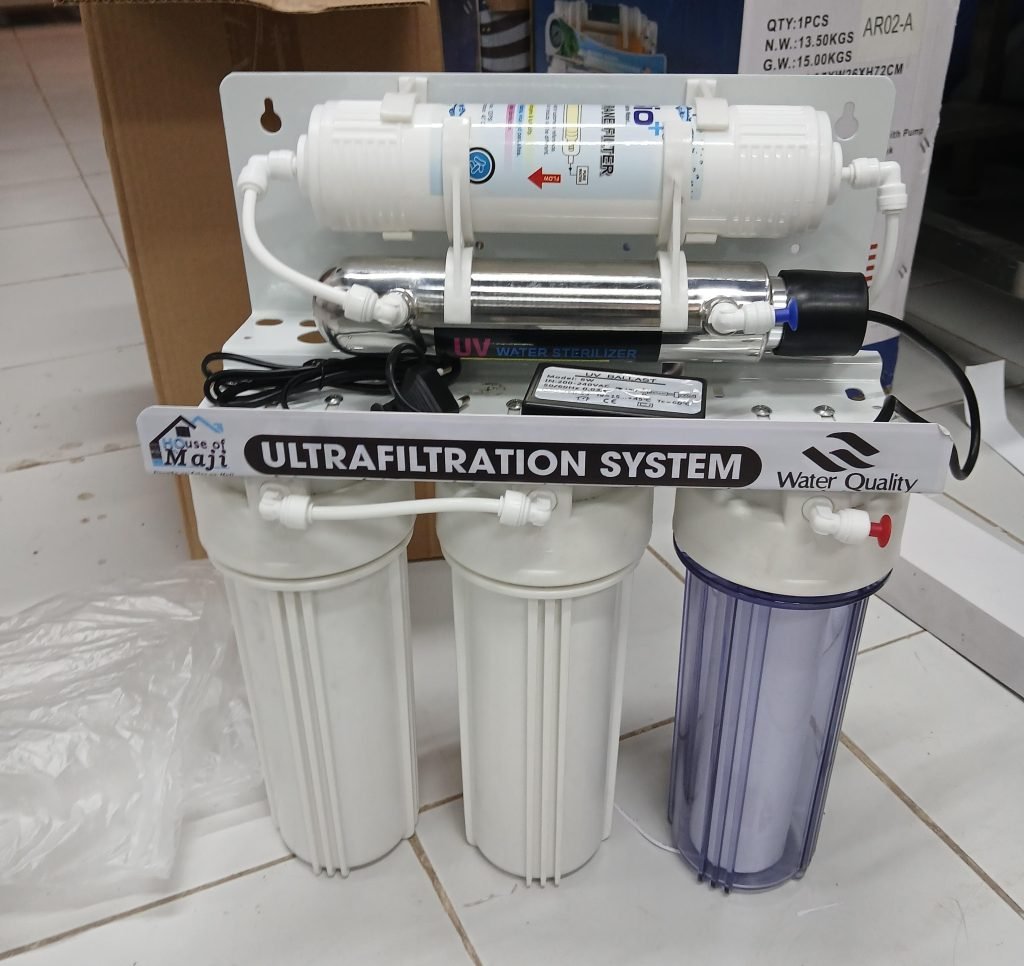
3. Water Softener – Best for Hard Water Damage
What it removes: Calcium and magnesium – the minerals that cause white scale, dry skin, stiff laundry, and ruined water heaters.
What it does NOT remove: Bacteria, heavy metals, chlorine, taste, or smell.
Best for: Homes where you see white buildup on faucets, soap doesn’t lather well, or kettles die every year.
Why homeowners love it: Softer skin, cleaner dishes, longer appliance life. Your water heater will thank you.
Trade-off: Does not make water safe to drink – only stops scale. You may still need another system for drinking water.
4. UV Treatment – Best for Borehole Water with Bacteria
What it removes (neutralizes): Bacteria, viruses, parasites.
What it does NOT remove: Heavy metals, chemicals, taste, sediment, hardness.
Best for: Homes on borehole or well water that tests positive for coliform or E. coli.
Why homeowners love it: Chemical-free. Kills germs instantly. No bad taste added.
Trade-off: Water must be clear (needs a sediment filter before it). Does nothing for chemical contamination.
5. Combination Systems – Best for Homes with Multiple Problems
Most homes do not have just one problem. You might have:
- Borehole water with bacteria AND hardness → Sediment filter + UV + softener
- City water with chlorine AND high TDS → Carbon filter + RO
- Borehole water with sediment AND heavy metals → Sediment filter + RO
Why homeowners love them: One integrated solution. No piecemeal fixes.
So Which Is the Best Water Treatment System for a Home?
There is no single “best” for every home. But here is a simple decision tree:
Step 1 – Test your water.
Order a basic test for TDS, pH, hardness, and bacteria. Cost is small. Mistakes are expensive.
Step 2 – Identify your main problem using the table below.
| Test result | Your main problem | Best system |
|---|---|---|
| High chlorine taste | Taste/odour | Carbon filtration |
| High TDS (>200 ppm) | Dissolved solids | Reverse osmosis |
| High hardness (>150 ppm) | White scale | Water softener |
| Bacteria detected | Germs | UV + sediment filter |
| Visible dirt/sand | Sediment | Sediment filter |
| Multiple issues | Combination | Custom design |
Step 3 – Choose whole-home vs point-of-use.
- Whole-home: Treats every tap. Good for sediment, chlorine, hardness.
- Point-of-use (under-sink): Treats only drinking water. Good for RO.
Step 4 – Buy from a company that tests first, not one that sells boxes.
Why House of Maji Is the Best Company to Visit for Home Water Treatment Systems
1. They Test Before They Sell – No Guessing
The biggest mistake in home water treatment is guessing. House of Maji starts every project with certified water analysis. They test the physical, chemical, and microbiological properties of your water – not the water next door. Then they recommend a system based on data, not commission.
2. They Have Installed Over 97 Homes – Real Local Experience
Their track record: 97+ homes installed. That is not theory. That is real experience with Kenyan water, Kenyan pipes, and Kenyan families. They know what works here and what fails.
3. They Offer Every Type of Home System
Whether you need a simple sediment filter, a whole-home carbon system, a water softener, an under-sink RO, or a UV system – they have it. They also design combination systems for homes with multiple problems.
4. They Do Not Oversell
If a basic carbon filter will fix your problem, they will tell you. If you do not need an expensive RO system, they will say so. That honesty is rare in this industry.
5. They Offer Nationwide Servicing and Maintenance
A water treatment system is not a “set it and forget it” purchase. Filters need changing. Systems need checking. House of Maji provides scheduled servicing, emergency repairs, and system optimization across Kenya. You are not left stranded.
Final Summary – Stop Guessing, Start Testing
The best water treatment system for a home is not the most expensive one. It is not the one your neighbour bought. It is the one that matches your water problems.
Three steps to get it right:
- Test your water – know what you are dealing with.
- Match the problem to the system – use the table above.
- Buy from a company that tests first – like House of Maji.
Your family drinks this water every single day. Do not leave it to chance.